
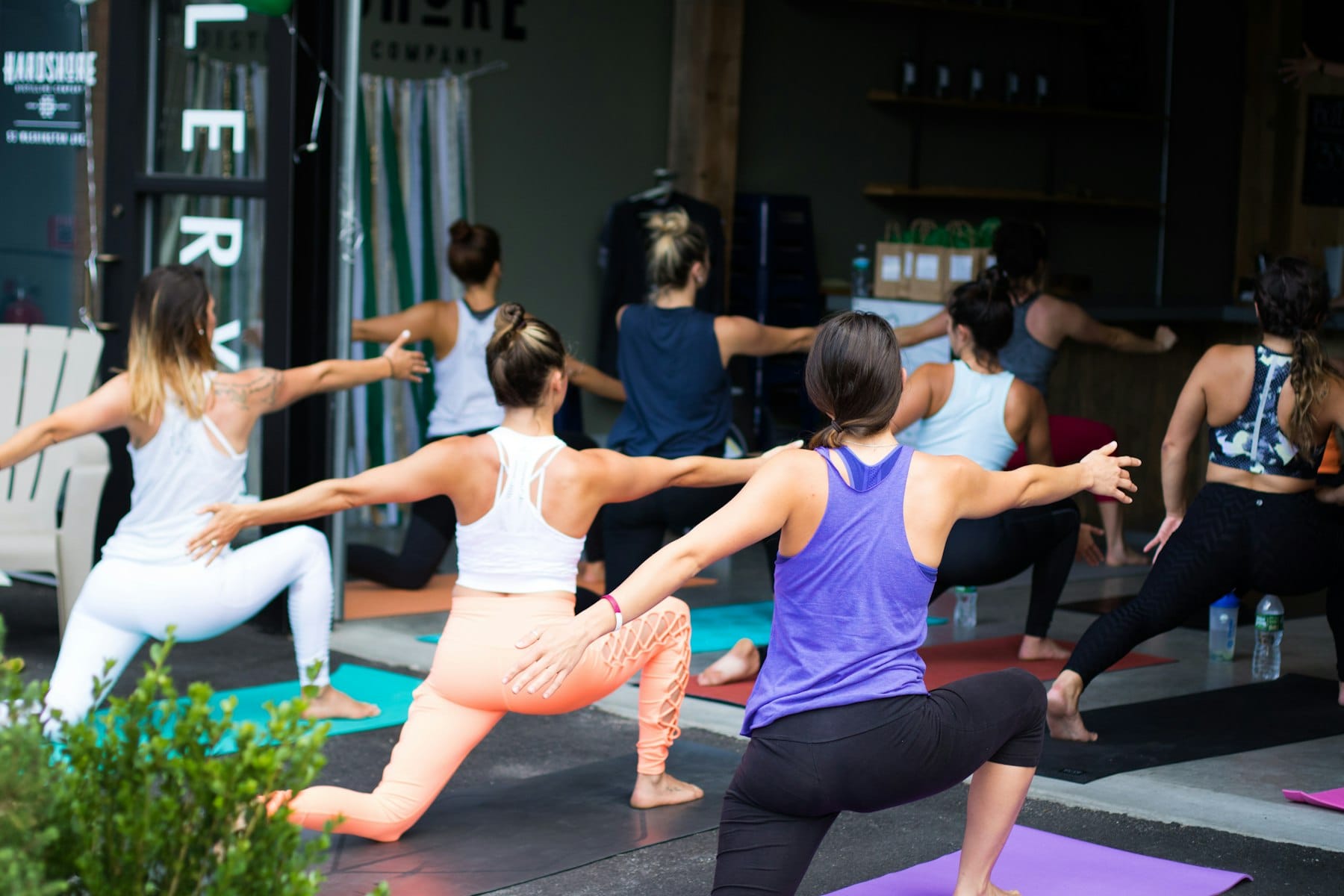
You can roll out a mat in your living room, press play on a good video and have a perfectly decent practice. So why do so many people say that yoga simply feels different when they do it with others? It is not only about motivation. Practising in a room full of people changes the way you breathe, the way you pay attention and even the way you hear music.
Here is a closer look at what happens when yoga becomes a shared experience, and how to get the most out of it.
The room sets the rhythm
At home, your pace is decided by your mood. If you are tired, you rush. If your phone buzzes, you stop. In a group, the rhythm is held for you. The teacher sets the tempo, everyone moves into the next pose at roughly the same time, and you are carried along instead of having to push yourself forward.
That is a relief for the mind. You no longer need to plan what comes next or decide when to stop. Your only job is to follow the breath and the cues. Many people find that this is exactly what makes it easier to switch off.
Moving together, breathing together
There is something quietly powerful about a room full of people inhaling as their arms rise and exhaling as they fold forward. Research on synchronised movement suggests that doing the same thing at the same time as others tends to increase feelings of connection and trust, even between strangers. Dancers, rowers and choirs have known this intuitively for a long time.
In yoga the effect is subtle. You are not looking at your neighbours or trying to match them perfectly. But you can hear the collective breath, feel the slight shift of energy when the whole room goes into a balance, and notice the silence when everyone settles. It is a form of togetherness that does not require conversation.
Fewer distractions, more presence
When you practise alone, the to-do list is never far away. In a class, the setting itself does part of the work:
- your phone is put away and out of reach
- the space is prepared for one purpose only
- you have committed time to be there, so you are less tempted to cut it short
- other people’s focus quietly reminds you to stay with your own
None of this means home practice is worse. It simply means that a group gives you a container, and a container makes it easier to stay present for the full session.
Gentle accountability, not competition
A common fear, especially for beginners, is being watched or judged. In reality, most people in a class are far too busy with their own breath to look at anyone else. If this worry is holding you back, our guide on your first yoga class covers what to expect and how to feel at ease.
What the group does offer is a soft kind of accountability. You are more likely to hold a pose a few breaths longer, or to stay for the final relaxation instead of rolling up your mat early. The aim is not to do more than others, but to do a little more than you would have done alone, at your own level.
Sound feels bigger with other people
Music changes in a shared space. A track you might play quietly on your laptop at home becomes something you feel through the floor when it is played live and the whole room is moving to it. The energy builds as people warm up, peaks during the stronger sequences and drops into calm together at the end.
This is one of the reasons we pair yoga with a live DJ set. The DJ can read the room and respond to it, stretching a slow moment when people need it or lifting the tempo when the energy is there. If you are curious about how sound shapes the practice, read how music changes your yoga practice.
The quiet after the practice
One of the most underrated parts of group yoga happens at the end. After the final relaxation, there is often a moment when people sit up slowly, look around, and realise they have shared something without saying a word. Some leave in silence, others stay for a short chat. Both are fine.
In a world where most of our social time happens through screens or in loud bars, this kind of calm, sober, shared experience can feel surprisingly rare.
How to get the most out of practising in a group
If you are used to practising alone, a few small habits help:
- arrive a little early so you can settle before the session starts
- choose a spot where you can hear the teacher clearly
- focus on your own breath first, then let yourself notice the room
- rest whenever you need to; nobody is keeping score
- stay for the final relaxation, as it is where much of the benefit tends to land
Practise with us
Electronic Yoga brings breath, movement and a live DJ set together in one shared session. Join a live session, currently in Barcelona: get your tickets here. And if you want to bring the atmosphere home in the meantime, listen to our Electronic Yoga sets on SoundCloud.