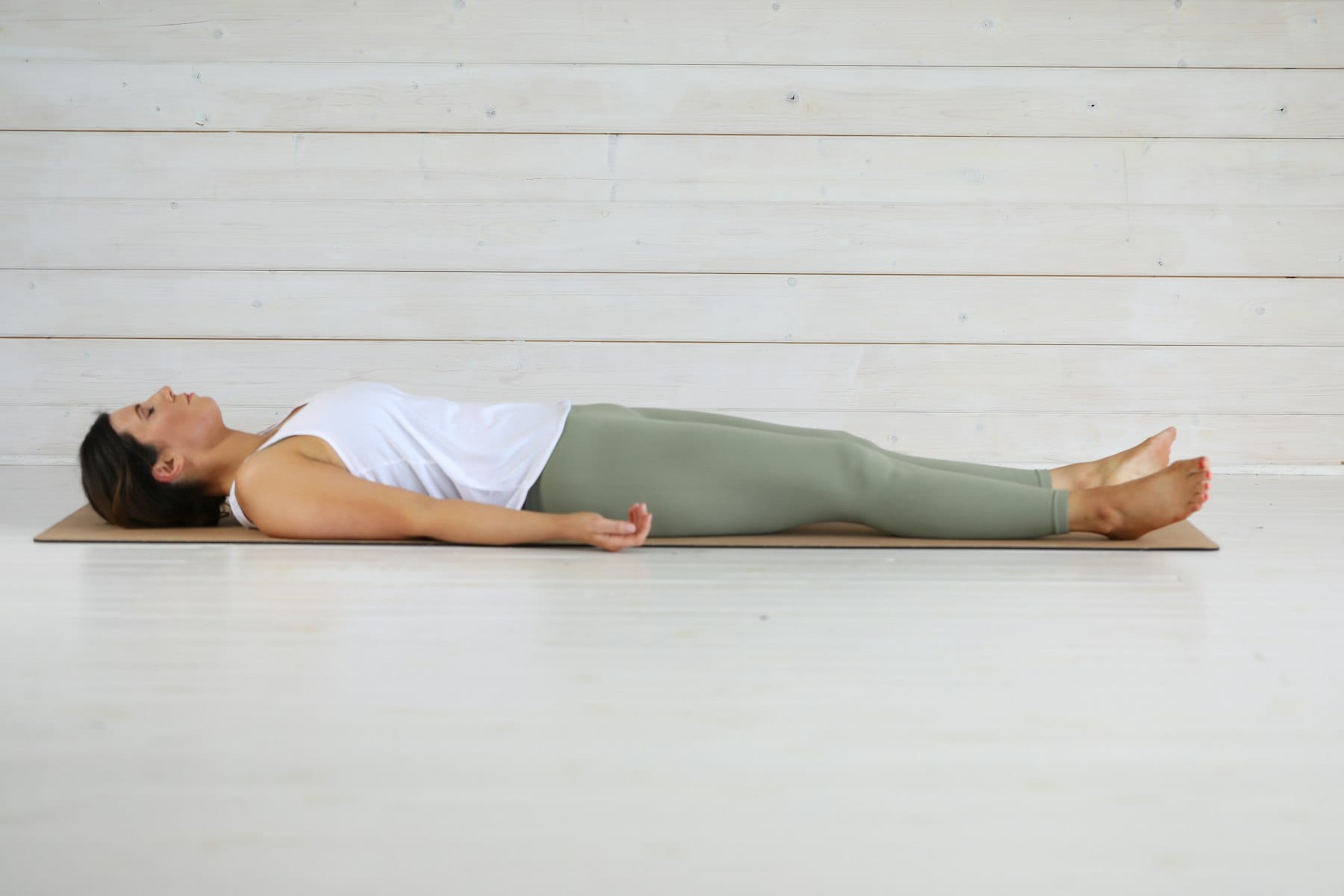
Savasana is the pose that looks like doing nothing. You lie on your back, let your arms and legs fall open, close your eyes and stay there. In a busy class it is often the moment people are tempted to skip: roll up the mat, check the phone, beat the queue at the door.
Yet many teachers describe it as the most important part of the practice. Here is why the final relaxation matters, what tends to happen in those few quiet minutes, and how music can help you actually land in it.
What savasana is
The Sanskrit name is usually translated as “corpse pose”. It sounds grim, but the idea is simple: complete stillness, with no effort and no goal. You are not stretching, not holding, not correcting your alignment. You are letting the body and mind take in what the practice has just done.
In most styles of yoga, savasana comes at the very end, after the movement and the breathwork. It can last a few minutes or much longer, depending on the class.
Why the final relaxation matters
After a sequence of poses, the body is warm and the attention is turned inward. Savasana gives that state somewhere to go. Instead of jumping straight from effort to the street, you leave a gap for things to settle.
A few reasons it tends to feel so valuable:
- A transition, not an ending. Moving from activity to rest gradually is often easier on the nervous system than stopping abruptly. Research on relaxation practices suggests that slow, quiet rest can help the body shift towards a calmer state.
- Time to notice. Without anything to do, you start to notice sensations you rushed past: warmth in the hips, a looser jaw, the rhythm of your own breath.
- Practice for letting go. Doing nothing on purpose is a skill. Many people find it harder than any balance pose, and it gets easier with repetition.
- Integration. Teachers often describe savasana as the moment the practice “sinks in”. It is less a scientific claim than a common experience: the session feels complete instead of interrupted.
Why it can feel so difficult
If you have ever lain in savasana and found your mind racing through a to-do list, you are not alone. Stillness tends to make restlessness more visible, not less.
That is normal. The point is not to empty the mind but to stop feeding it. Each time you notice you have drifted into planning, come back to something simple: the weight of the body on the floor, or the air moving in and out of the nose.
How to get more out of savasana
A few small adjustments can make a big difference, especially if you practise at home:
- Get comfortable first. Place a folded blanket under your knees if your lower back complains, or a thin cushion under your head.
- Stay warm. The body cools quickly when you stop moving. Socks or a light blanket over you help you relax instead of shivering.
- Let the feet and hands fall open. Palms facing up, legs a little wider than the hips. Release any effort to hold a “correct” shape.
- Soften the face. Unclench the jaw, let the tongue rest, relax the space between the eyebrows.
- Give it real time. Five minutes is a good starting point. Set a gentle timer so you are not tempted to check the clock.
- Come out slowly. Wiggle fingers and toes, roll to one side, rest there for a few breaths, then sit up.
If you want a full practice to end with, try our hip-opening sequence with slow music, which naturally winds down towards stillness.
The role of music in final relaxation
Music can be a helpful companion in savasana, as long as it supports stillness rather than demanding attention. In an electronic yoga session, the final minutes are usually where the set becomes most spacious: the beat drops away, textures stretch out and the sound slowly fades.
What tends to work well at home:
- Beatless or nearly beatless tracks. Ambient and drone music give the mind something soft to rest on without a pulse to follow.
- Low volume. Quiet enough that you could fall asleep, loud enough that you are not straining to hear it.
- A gentle ending. A slow fade-out or a few seconds of silence lets you come back on your own terms instead of being jolted by the next song.
Some people prefer complete silence, and that is fine too. Try both and notice which leaves you calmer afterwards.
Pairing savasana with your breath
Even in stillness, the breath is a useful anchor. You do not need to control it; simply notice it. If your mind is very busy, you can count a few slow breaths, then let the counting go.
For a short, guided way into this, our 10-minute breathing practice with music works well right before you lie down.
Don’t skip the ending
It is tempting to treat savasana as optional, the bit you can drop when you are short on time. But a shorter practice with a proper rest at the end often feels more complete than a longer one that stops abruptly.
Next time you roll out your mat, protect those last few minutes. Lie down, let go, and let the practice finish its work.
Experience it live
In an Electronic Yoga session, the final relaxation is built into the music: breath, movement and a DJ set that gradually dissolves into stillness. Join a live session — currently in Barcelona, or press play on our Electronic Yoga sets on SoundCloud and give yourself a proper savasana at home.